

Varonis Threat Labs recently discovered AvisLoader, a new Windows loader named after the Latin word for bird. We found it on an exposed staging server alongside a ClickFix lure, supporting tools, and its Command Center.
The attack starts with a familiar ClickFix lure. A page posing as a document-signing request asks visitors to copy and run an attacker-supplied command on their machine.
The more interesting part is how AvisLoader stays connected. It communicates via Tox, an encrypted peer-to-peer (P2P) messaging network that carries commands and additional payloads from the operator.
That setup makes traditional domain-based takedowns harder. The command-and-control (C2) channel does not depend on a fixed domain or server address, and operators can keep the same identity when moving to another server.
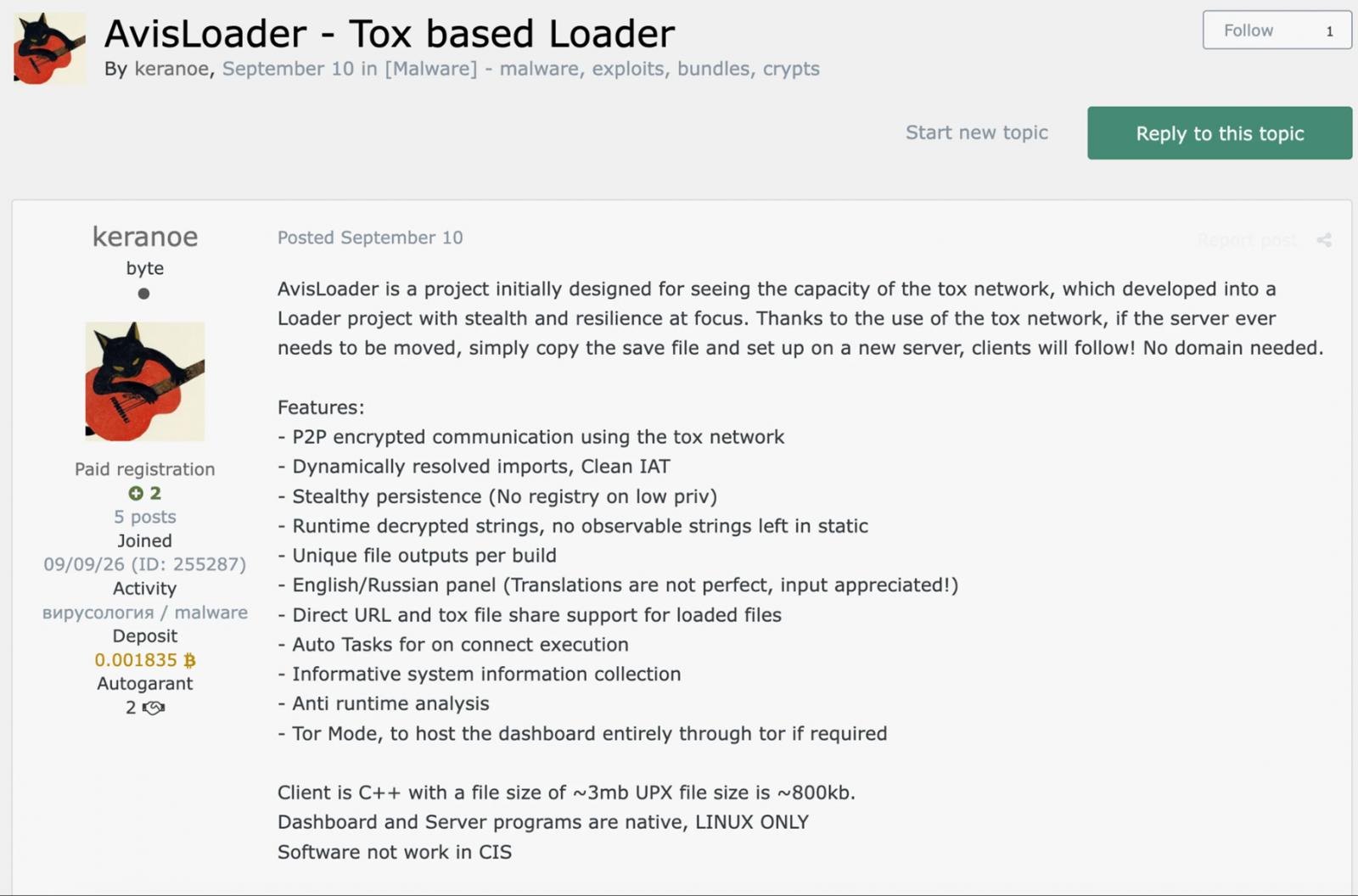
The seller references this in a cybercrime forum listing, claiming the controller can be moved by copying its Tox save file, with clients following without the need for a domain.
In this post, we look at how AvisLoader works, the MITRE ATT&CK techniques it uses, and the indicators security teams can use to detect it.
Delivery through ClickFix and Cloudflare
The specific ClickFix lure we found alongside AvisLoader was hosted on Cloudflare Workers and made to look like a DocuSign signing request.
A fake “Manual verification” dialog claims “Verification is handled by Cloudflare” and asks visitors to paste a “verification code” into a terminal. It presents running the command as a step needed to access the document.
What lands on the clipboard is a command that retrieves and runs code from a Cloudflare Quick Tunnel address on trycloudflare.com. A download still takes place, but through the pasted command, outside the browser’s normal download flow.