

A cairn is a marker left behind on a trail, a deliberately placed stack of stones that helps hikers find their way when the path is unclear. Attackers building AI-integrated malware unintentionally (and inevitably) leave behind markers of their own: prompt templates, provider endpoints, API keys, jailbreak terms, and other artifacts embedded throughout their tooling.
When we consider these strings as cognitive artifacts, or vestiges left behind from AI integration, we can enable a new, metadata-first hunting methodology for AI-integrated malware that is fast and scalable. These artifacts can be extracted, related, and classified without ever touching the underlying binary.
Today, Cisco Talos is releasing this methodology in the form of CAIRN (Cognitive Artifact Intelligence Research Network), a research toolkit for hunting, classifying, and tracking emerging AI-integrated malware. Over time, we will share the full contents of our initial findings, starting today with CLOSEDQUORUM.
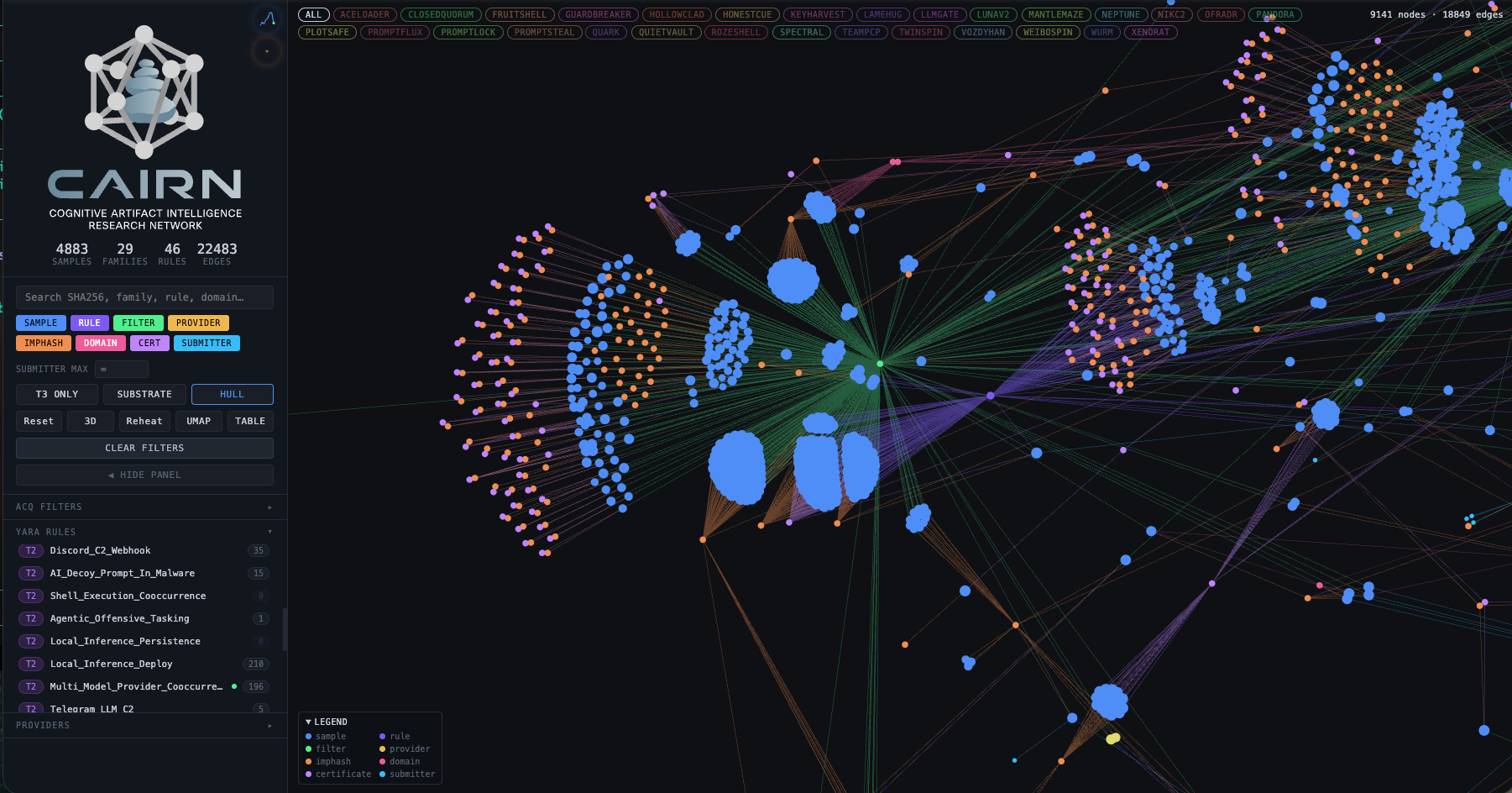
cairn explorer to launch the graph.CAIRN contains functionality for identifying AI-integrated malware; in our definition, that is malware that functionally operationalizes, explicitly targets, or exploits AI systems and their ecosystems — spanning functional integration into attack chains, credential and infrastructure compromise, and ecosystem-level abuse. These binaries are classified based on pre-defined AI-usage archetypes, and reporting findings in a structured way.
CAIRN has an explorer layer, which creates a structured graph of cognitive artifact relationships to help defenders identify related malware families, infrastructure, and threat actors.
Metadata-first architecture
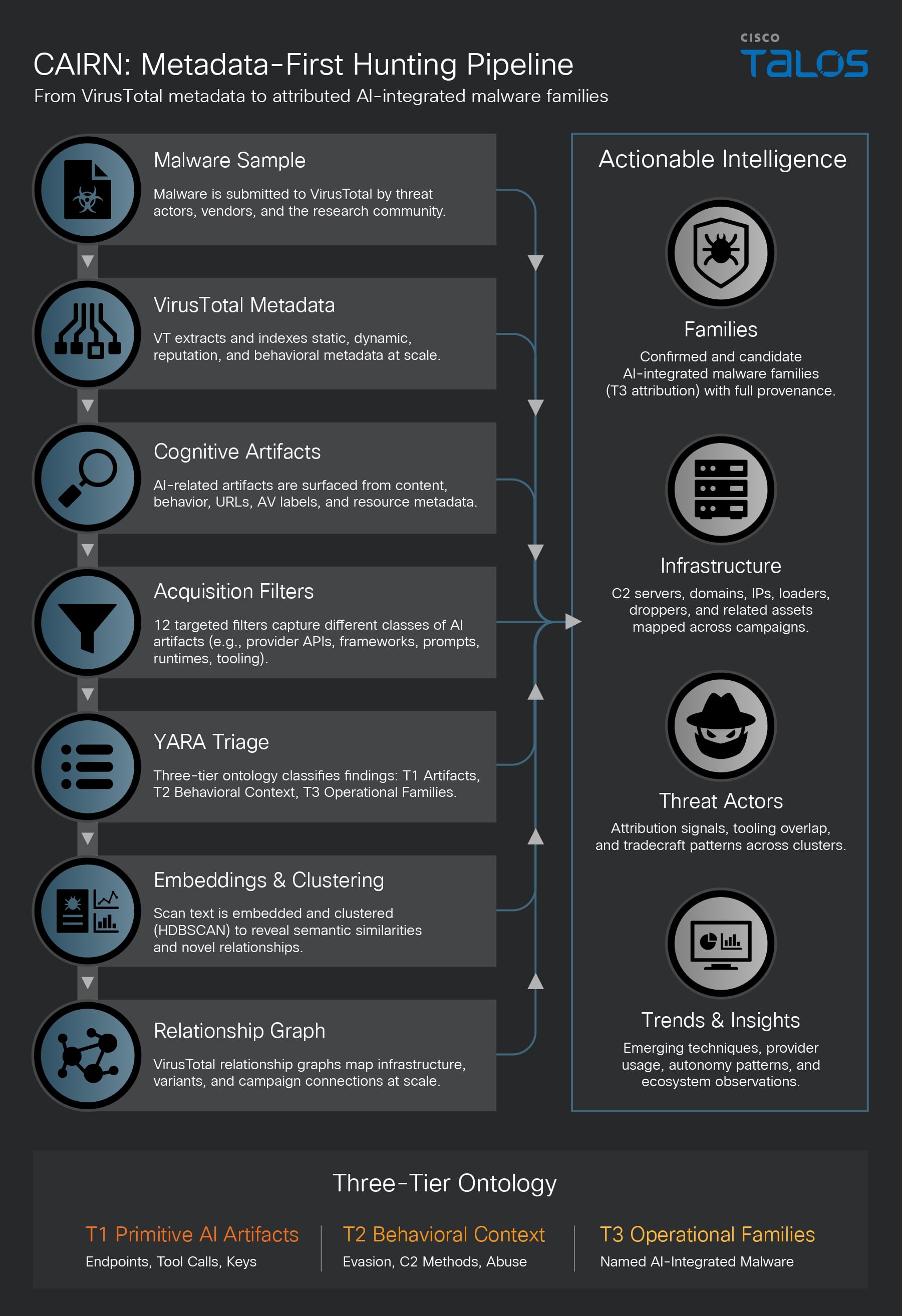
CAIRN operates entirely from metadata — no binary downloads or execution required. It combines rule-based detection, semantic clustering, and relationship graph traversal to identify AI-integrated malware through cognitive artifacts such as embedded prompts, provider endpoints, orchestration logic, API key prefixes, and AI-analysis evasion strings.
CAIRN discovers candidate samples through up to 24 acquisition filters, each targeting a different type of AI-related artifact. Instead of relying solely on filenames or hashes, these filters search across metadata including extracted strings, sandbox behavior, and antivirus (AV) detection labels.