

Microsoft Security Research has identified malicious cloud activity associated with JADEPUFFER, a threat actor discovered by Sysdig in July 2026 and reported to be the first documented agentic ransomware operation. Our investigation found an extensive Azure-focused resource destruction activity using compromised service principals and cloud credential collection that could be used to facilitate future exfiltration.
These findings expand the publicly documented activity associated with JADEPUFFER, tracked by Microsoft as Storm-3168, demonstrating an evolution in the threat actor’s cloud operations and providing the first detailed view into its Azure activity. We identified bulk destructive operations in a compromised Azure environment. The destructive operations were facilitated by compromising service principals and targeted Azure Storage Accounts, SQL databases, Key Vaults, Function Apps, recovery protection locks, Virtual Machines, and App Services.
Organizations can reduce exposure by protecting workload identities and secrets, enforcing least privilege, safeguarding recovery resources, and enabling relevant Microsoft Defender for Cloud protections. Publicly exposed credentials remain usable until revoked or rotated; removing the original disclosure alone does not remediate the exposure.
This activity highlights a broader shift toward AI-orchestrated attacks, where threat actors can coordinate complex post-compromise operations across cloud environments with greater speed and scale. As these capabilities evolve, defenders must similarly use AI to investigate and respond across large environments. Rather than requiring analysts to manually follow each individual action, efforts such as Project Perception and MDASH are intended to support a model in which defenders can investigate and respond across increasingly large and complex environments using AI.
Attack overview
Microsoft observed two compromised service principals belonging to the same tenant. One performed reconnaissance and resource discovery. The other performed discovery, destructive operations, and credential collection.
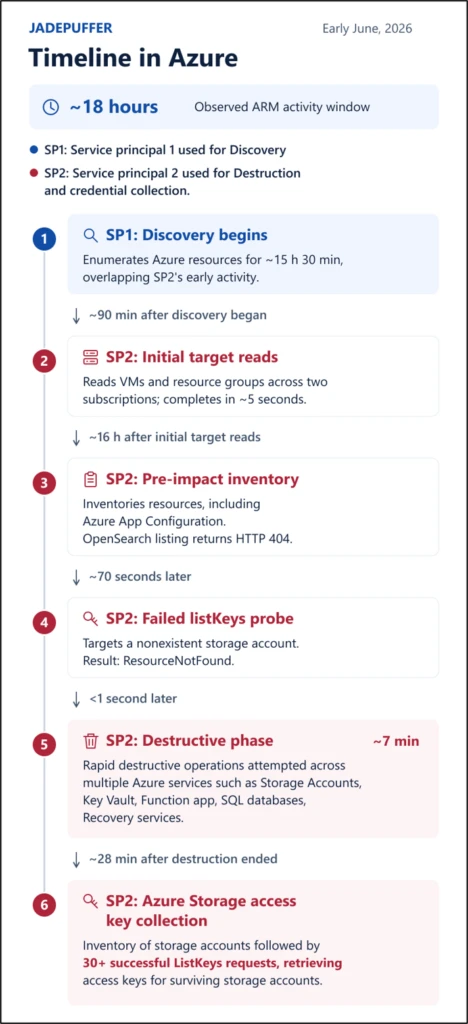
Discovery before destruction
For the impacted tenant, in early June 2026, one of the compromised service principals enumerated Azure Virtual Machines, subscriptions, resource groups and resources for about 15 hours and 30 minutes with 300+ successful read operations. This breadth of activity would give the threat actor visibility across the organization’s Azure environment.
About 90 minutes after the first compromised service principal started enumeration, the second compromised service principal enumerated virtual machines and resource groups across two subscriptions in five seconds. Both service principals used Storm-3168 linked infrastructure, the same network fingerprint, and the user agent python-requests/2.34.2.
16 hours later, the second service principal successfully enumerated Azure App Service configuration stores, possibly looking for exposed credentials. It also unsuccessfully attempted to look for Azure OpenSearch resources.
70 seconds after this final inventory operation, the same service principal also attempted a ListKey operation against a non-existent storage account.
A seven-minute destructive sequence
Less than one second after the unsuccessful ListKey operation against a non-existent storage account, the second compromised service principal began with its destructive activities. This compromised service principal then attempted 150+ destructive or credential collection related operations in 35 minutes.
The destructive sequence lasted for about 7 minutes. This involved 100+ storage account deletion attempts. Most Azure Storage accounts targeted by the threat actor were successfully deleted. However, Azure resource locks and storage account-level deletion protection blocked deletion attempts for few of the storage accounts, demonstrating the value of independent safeguards that remain effective even when a compromised identity has broad administrative permissions. An Azure Key Vault, Function App, App service plan were also deleted, all of which belonged to the same resource group and appeared to support the Function app.