


By Sila Ozeren Hacioglu, Security Research Engineer at Picus Security.
For years, security teams had a window of several weeks between a CVE going public and attackers exploiting it. Every year, that window got smaller. Then Mythos-class models arrived, and attackers can now weaponize a new CVE within hours. That leaves security teams very little time to find out whether they’re exposed.
That’s where offensive testing comes in. But it has traditionally run on a schedule. Over the years, that schedule got tighter. Annual pentests became quarterly, and automated penetration testing tools made weekly testing possible.
Each advancement shortened the time a change could go untested. Traditional automated pentesting worked fine back when exploitation took weeks. Now that attackers have made a big jump, offensive testing is making one too.
That jump is agentic pentesting. It’s the sharp edge of offensive testing today, but it has blind spots. This piece looks at where they are and how to close them.
How Agentic Pentesting Should Work
A manual pentest usually goes through several phases: reconnaissance, vulnerability assessment, initial access, post-exploitation, and reporting. Traditional automated pentesting tools follow the same phases. Even before LLMs took off, some advanced tools used machine learning to choose the next step. For example, five years ago, we built our Attack Path Validation (APV) product with such a decision engine. But AI agents take it further.
In agentic pentesting, one or more AI agents carry out a pentest step by step. In our agentic pentesting product, Picus Swarm uses five specialist agents orchestrated by Numi AI.
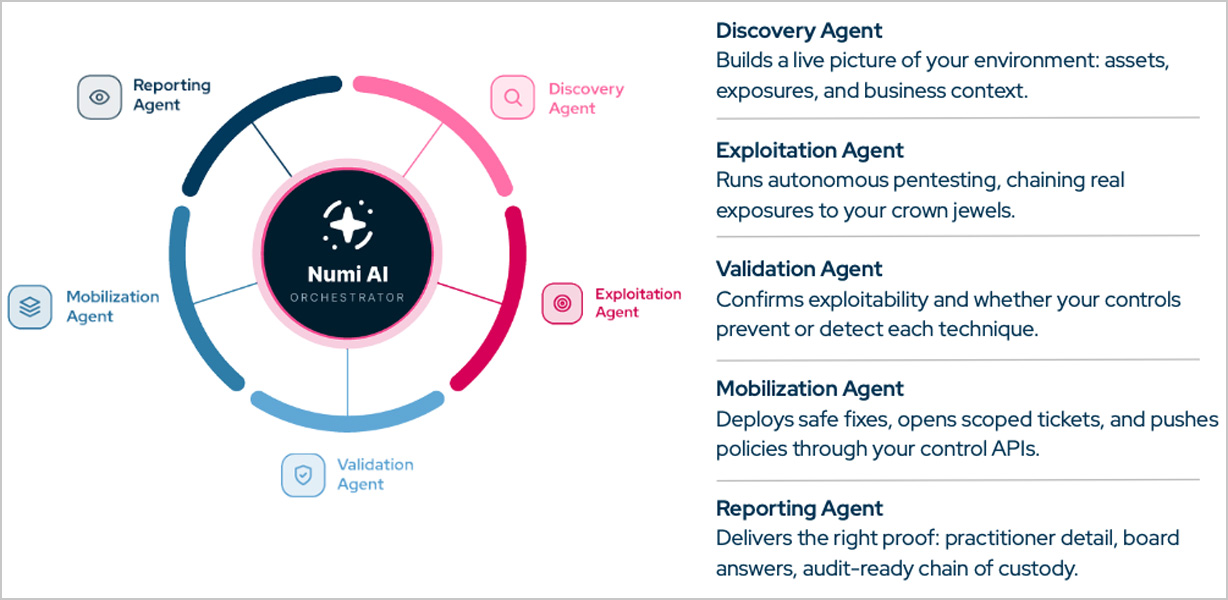
AI pentest agents evaluate findings and your organization’s context to choose the next step dynamically. That creativity lets them find exploit chains much faster than a human pentester, including some a human might miss entirely. However, creativity comes at a cost.