

Microsoft introduces the cloud web applications threat matrix, a MITRE ATT&CK-aligned framework that helps defenders understand, prioritize, and mitigate threats to cloud-hosted web apps and serverless platforms.
Cloud-hosted web applications and serverless platforms create attack paths that can cross application code, managed runtimes, workload identities, deployment pipelines, and connected cloud resources. Investigating the application and underlying cloud platform separately can leave gaps in how defenders understand those paths.
Microsoft developed the Cloud web applications threat matrix to organize relevant techniques using MITRE ATT&CK tactics. The matrix can help security teams assess visibility gaps, prioritize hardening, and plan investigations across cloud-native environments. This blog introduces the framework, examines selected techniques, and outlines defensive priorities for reducing exposure.
Overview
Cloud-hosted web applications and serverless platforms let teams deploy and scale application logic quickly, but they also create attack paths that cross application code, managed runtimes, identities, deployment pipelines, and connected cloud services. These paths can be difficult to detect when the application layer and underlying cloud platform are investigated separately.
To provide a clear and consistent view of the threat landscape affecting cloud hosted web applications and serverless environments, we organize techniques using the MITRE ATT&CK format. Building on Microsoft’s previously published threat matrices for Kubernetes and storage services, this matrix expands coverage for cloud web applications– applications that execute code in a managed environment, are often tightly integrated with other cloud resources, and are commonly exposed to the internet.
The attack techniques presented in this matrix are divided into the following tactics, aligned with the MITRE ATT&CK framework:
- Resource Development
- Initial Access
- Execution
- Persistence
- Privilege Escalation
- Defense Evasion
- Credential Access
- Discovery
- Lateral Movement
- Collection
- Impact
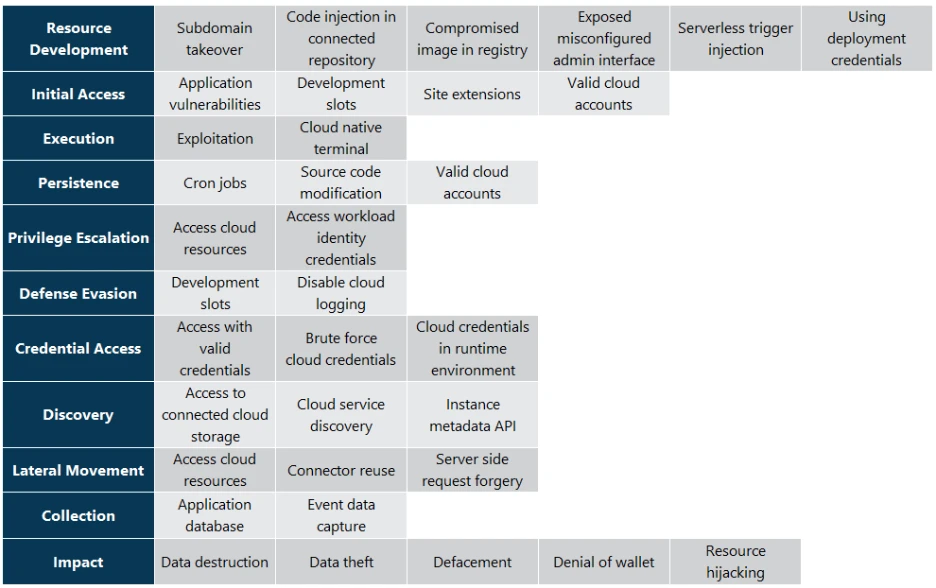
Technique Catalog
Below, we walk through each tactic and describe its techniques in more detail.
Resource Development
The resource development tactic consists of techniques that adversaries use to establish resources they can use to support operations. This may include acquiring infrastructure, developing capabilities, or compromising resources that can later be used during targeting.
Subdomain takeover
Deleting a cloud application or service without removing its associated DNS record pointed to a reusable provider endpoint can create a subdomain takeover risk. Depending on the provider’s behavior, service configuration, and naming constraints, a threat actor may be able to register a resource that claims the same address and intercept traffic intended for the original service, potentially serving malicious content or harvesting credentials.
Initial Access
The initial access tactic consists of techniques that are used for gaining access to cloud web applications and serverless environments. This access can be achieved through compromised credentials, vulnerable applications, misconfigured interfaces, or by exploiting connected resources.
Application vulnerability
Running a public-facing web application that hosts a vulnerable application can enable adversaries to access and execute code in the context of the web application, or to access internal resources and gain a foothold in the cloud environment. Such vulnerabilities could stem from the application’s own code, its underlying framework, or third-party libraries and dependencies it uses.
Code injection in connected repository
Threat actors may inject malicious code into source repositories that are linked to cloud web applications or serverless functions. If these repositories are automatically synced with production environments, the injected code executes under the legitimate workflows.
For example, if a threat actor gains commit permissions to a GitHub repository that is configured to deploy GCP Cloud Functions through Cloud Build triggers, their code may be deployed into the application through the legitimate pipeline.