
Threat Intelligence & APT SecurityWeek 1 week ago

US Seeks Alleged Chinese Hafnium Hacker With $10 Million Reward

CN
CyberNew Threat Research Desk
• Original Reporting: SecurityWeek
CyberNew Threat Intel Assessment
Assessed Severity: MEDIUM
Impacted Surface
Enterprise Perimeter & Network Defense
Intelligence Sector
Threat Intelligence & APT

Analyst Takeaway

"The US Department of State is offering up to $10 million for information on Zhang Yu, a Chinese national accused of taking part in the Hafnium campaign against Microsoft Exchange servers. The State Department’s Rewards for Justice (RFJ) program announced the reward on Wednesday. Zhang is charged alongside Xu Zewei, who was extradited from Italy to the US in April 2026. According to RFJ, Zhang is..."

Recommended Defense & Mitigation

  • Threat Monitoring: Ingest published IOCs into SIEM/EDR detection rules for continuous telemetry monitoring.
  • Security Awareness: Alert staff and maintain baseline endpoint hardening across endpoints.
Curated & Verified by CyberNew Threat Intelligence Desk Standard Defense Framework (NIST / MITRE ATT&CK)
Chinese Hafnium hacker reward

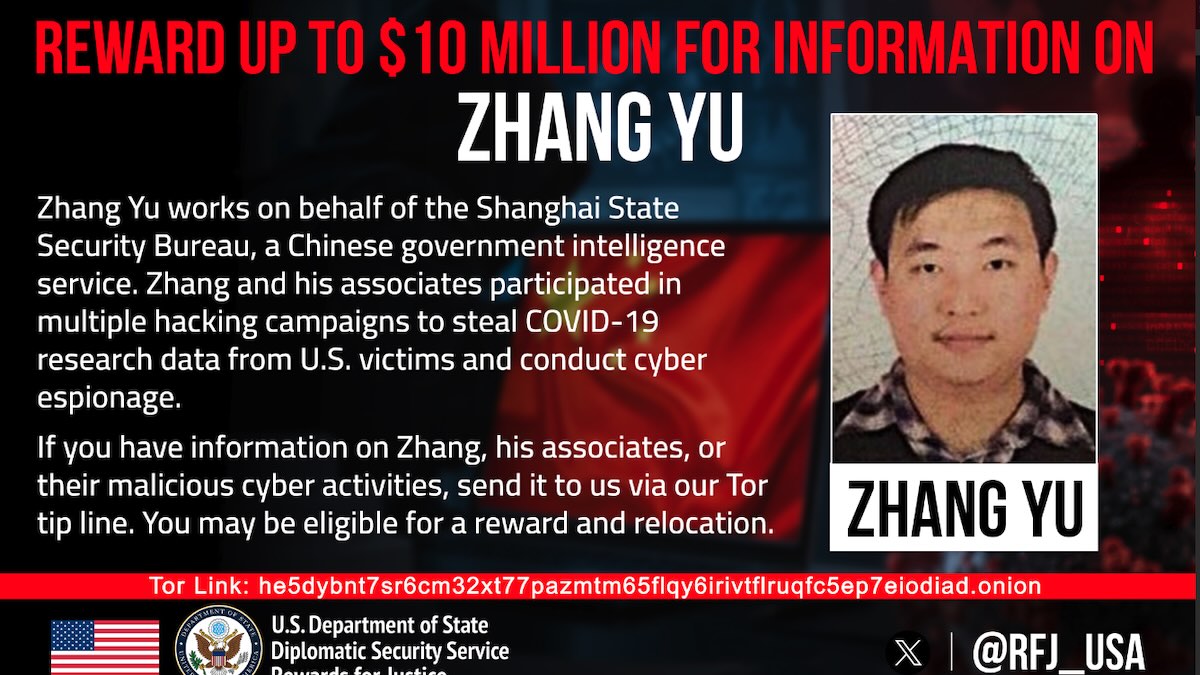
The US Department of State is offering up to $10 million for information on Zhang Yu, a Chinese national accused of taking part in the Hafnium campaign against Microsoft Exchange servers.

The State Department’s Rewards for Justice (RFJ) program announced the reward on Wednesday. Zhang is charged alongside Xu Zewei, who was extradited from Italy to the US in April 2026.

According to RFJ, Zhang is a director at Shanghai Firetech Information Science and Technology Company. He allegedly worked on behalf of the Shanghai State Security Bureau (SSSB), part of China’s Ministry of State Security (MSS).

Zhang and Xu were named in a nine-count indictment unsealed in July 2025, days after Italian police arrested Xu in Milan at the request of the US. Xu has since appeared in federal court in Houston, while Zhang remains at large.

“Starting in early 2020, Zhang and his partner Xu Zewei, then a general manager at Shanghai Powerock Network Co. Ltd., gained unauthorized access to COVID-19 research conducted by US-based universities and leading immunologists and virologists to steal sensitive information,” RFJ said.

The following year, the two allegedly exploited vulnerabilities in Microsoft Exchange Server as part of Hafnium. RFJ says the campaign compromised thousands of computers worldwide, and its victims included a US university and a US law firm.

Advertisement. Scroll to continue reading.

Written By Eduard Kovacs

Source Verification & Original Intelligence

This threat report was reviewed by CyberNew analysts and cross-referenced with primary security disclosures from SecurityWeek.

Primary Advisory →