

The Traffic Light Protocol (TLP)[1], which is now in its second incarnation, is a wonderful standard that enables one to easily communicate whether information may be shared further (and if so, how far).
That being said, I've noticed a somewhat unfortunate trend in a number of organizations that try to fit TLP into a niche it was never supposed to occupy by attempting to use its labels as a replacement for traditional internal information classification schemes.
At first glance, this may seem quite reasonable. After all, TLP is a well-known standard, and it defines a simple set of labels for restricting the sharing of information (as you can see in the following table). And since most organizational classification schemes also consist of only a few levels, why not use TLP instead of maintaining a separate set of labels?
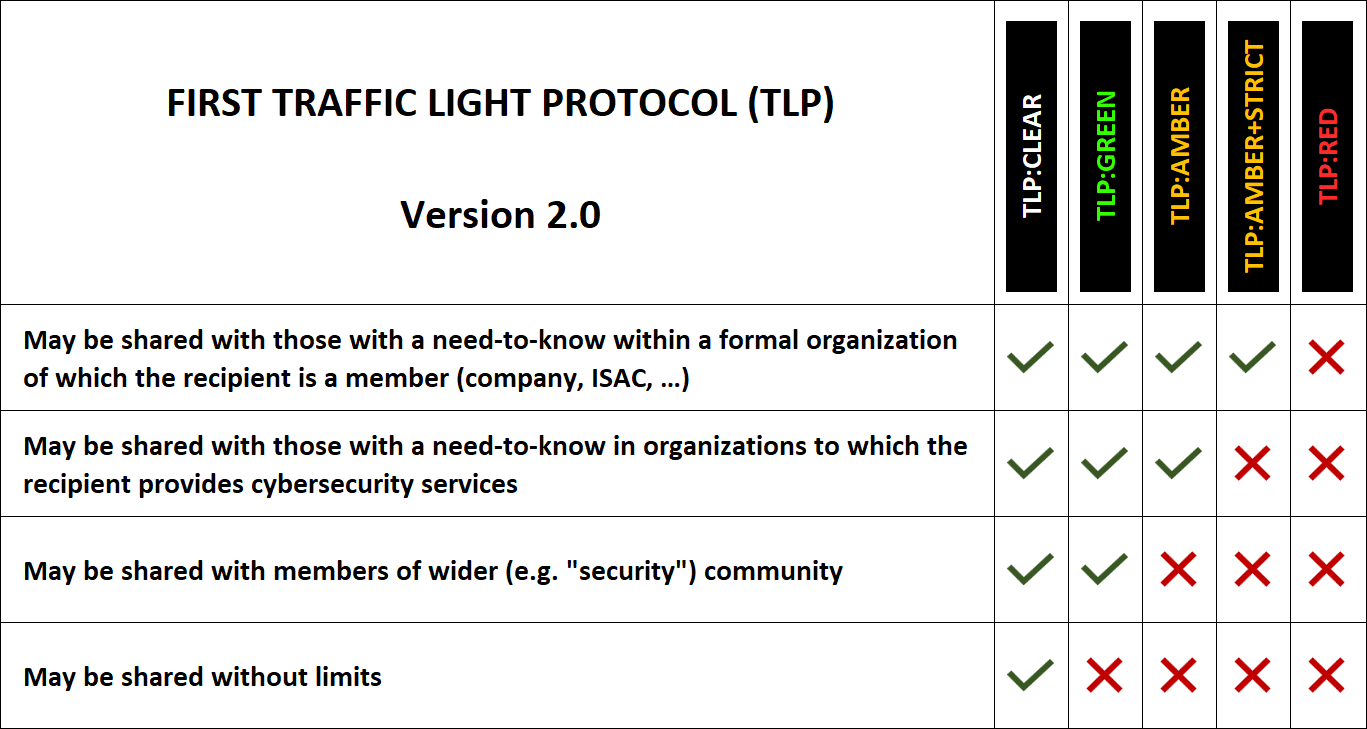
Unfortunately, there are several reasons why this might not be the best idea.
The first is that TLP was never intended to be used in this way. In fact, the official TLP 2.0 standard explicitly states that “TLP is not a formal classification scheme” and that it was not designed to define information handling or encryption rules. Its purpose is to specify with whom information may be shared, not how it should be protected. While these two aspects are certainly related, they are far from being interchangeable.
An internal information classification scheme may, for example, define requirements for encryption, storage, access control or retention of information with different sensitivity levels. None of these requirements can be inferred from a TLP label alone.
For example, an organization may allow documents classified as "Sensitive" to be sent to customers, but only in encrypted e-mails or on encrypted USB drives. Even if a TLP label permits sharing with the intended recipients, it doesn't say anything about these requirements. To express them using TLP alone, the organization would have to add its own information handling rules to the labels – effectively creating a custom classification scheme.